Owning a category on a market where nobody keeps the pace
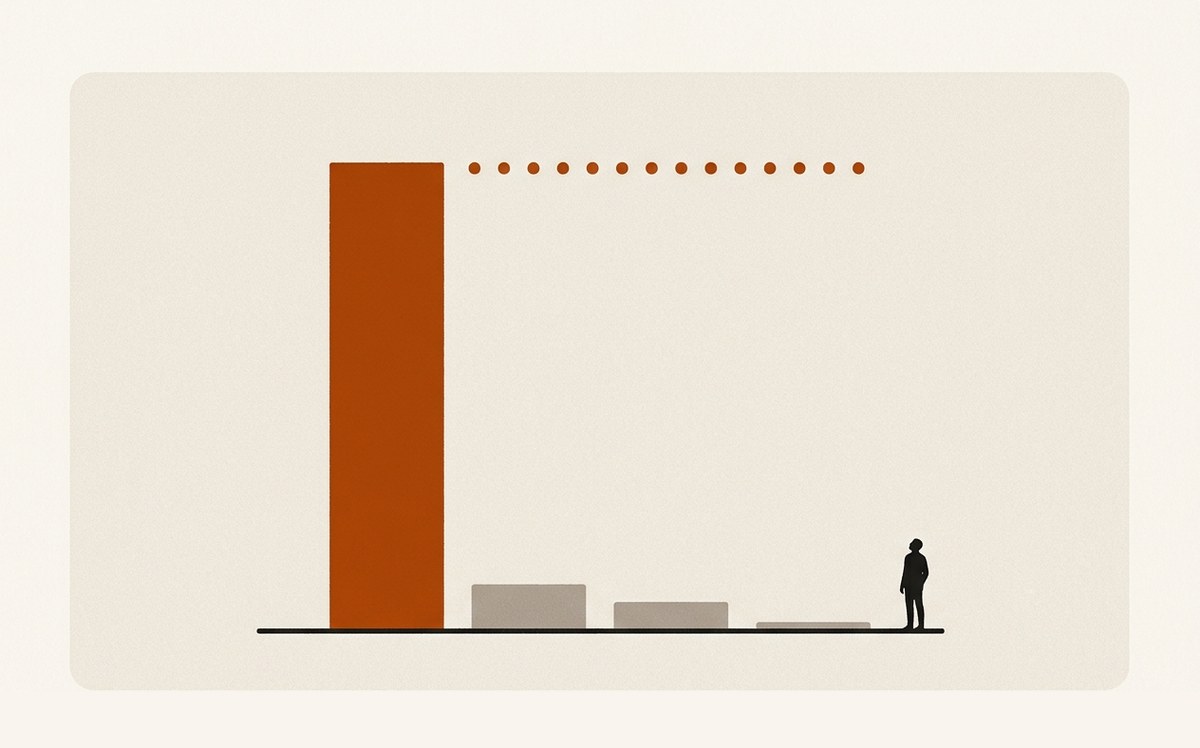
On a large market, share of voice is bought. On a small one, it is taken by being the only party that keeps a pace for three years. This account kept that pace.
By mid-period the brand held a community more than thirty times larger than the best established competitor in its category, and the next two did not reach a third of that competitor. This is not a budget gap. It is a consistency gap.
Everything else follows the same logic. A click-through rate of 0.085% when the sector reference quoted at the time was 0.03%, close to triple. A cost per follower of 0.29 euro when the market average sat around one euro. And an editorial plan delivered at 133% of what was scheduled.
A sports retail chain on an island market, with a dense commercial calendar and a family customer base. The category was contested hard on the ground, with several well established competing chains. On digital, though, nobody had really moved in. The account was built and held over three years, with two social pages, an email rhythm aligned to commercial operations, game applications at every peak, and the media buying to go with it.
A small market does not forgive irregularity, and it does not reward spend. The available budget could not buy presence, and in any case the addressable audience was too narrow to absorb volume: past a certain threshold, every extra pound retouches the same people. The only variable left was production consistency, which means a weekly team load, held even in quiet weeks, for three years.
1 · Set the editorial pace on the commercial calendar.
Not a content calendar invented alongside the business. The email pace followed every commercial operation, up to sixteen campaigns for a single operation, the densest pace in the agency's portfolio. The brand spoke when the store had something to say.
2 · Beat the plan rather than hold it.
The plan set a number of posts per period. I delivered 133% of it. On a long-term account, the gap between keeping a commitment and slightly beating it is what builds the distance over three years, because the competitor is already not keeping theirs.
3 · Measure against an outside benchmark, not against yourself.
A click-through rate means nothing on its own. Compared with the sector benchmark quoted at the time, it comes out at nearly three times as high. An indicator without a reference point justifies no budget, and yet that is how most social reports are written.
4 · Build the community on cost, not on volume.
A cost per follower of 0.29 euro against an average observed cost of around one euro. That cost came from content that travelled: every earned share reduced the paid share.
5 · Keep the category table, and show it to the client.
Every report carried the brand's position in its local category, with the competitors' communities alongside. That table is what made the budget unquestionable year after year, far more than the campaign indicators. A client renews when they see they are winning, not when they see they are posting.
2012 to 2014 account, summer 2013 report and mid-2014 category reading.
- Community more than thirty times larger than the best established competitor in the category
- 19 million impressions over the summer 2013 period alone
- Click-through of 0.085% against a sector reference quoted at 0.03%, close to triple
- Cost per follower of 0.29 euro against a market average around one euro
- Editorial plan delivered at 133% of scheduled volume
- Up to sixteen email campaigns for a single commercial operation, the densest rhythm in the portfolio
- Brand position in its local category tracked and presented at every report
On a narrow market, dominance is not a question of means, it is a question of presence held. Three years of steady cadence create a gap no competitor closes with a campaign, because the deficit is not in budget, it is in time. The only difficulty is that this discipline does not show quarter by quarter: it only reads in the category table.
Who keeps the pace in your category?
The first call30 minutes. We talk about your traction and what is blocking it. You leave with 2 or 3 moves you can act on. No pitch.
When the audience is not a customer but an investor
Constraint: an audience that decides without ever clicking.
Read the case studyOne institutional voice, built as a system
Constraint: a B2B sector where one wrong word costs credibility.
Read the case studyA full brand identity on a four-figure envelope
Constraint: a four-figure budget, in front of an institutional audience.
Read the case studyRunning a destination brand on an international market
Constraint: a brand judged by people who buy nothing.
Read the case study