The launch whose weak link was the dealership
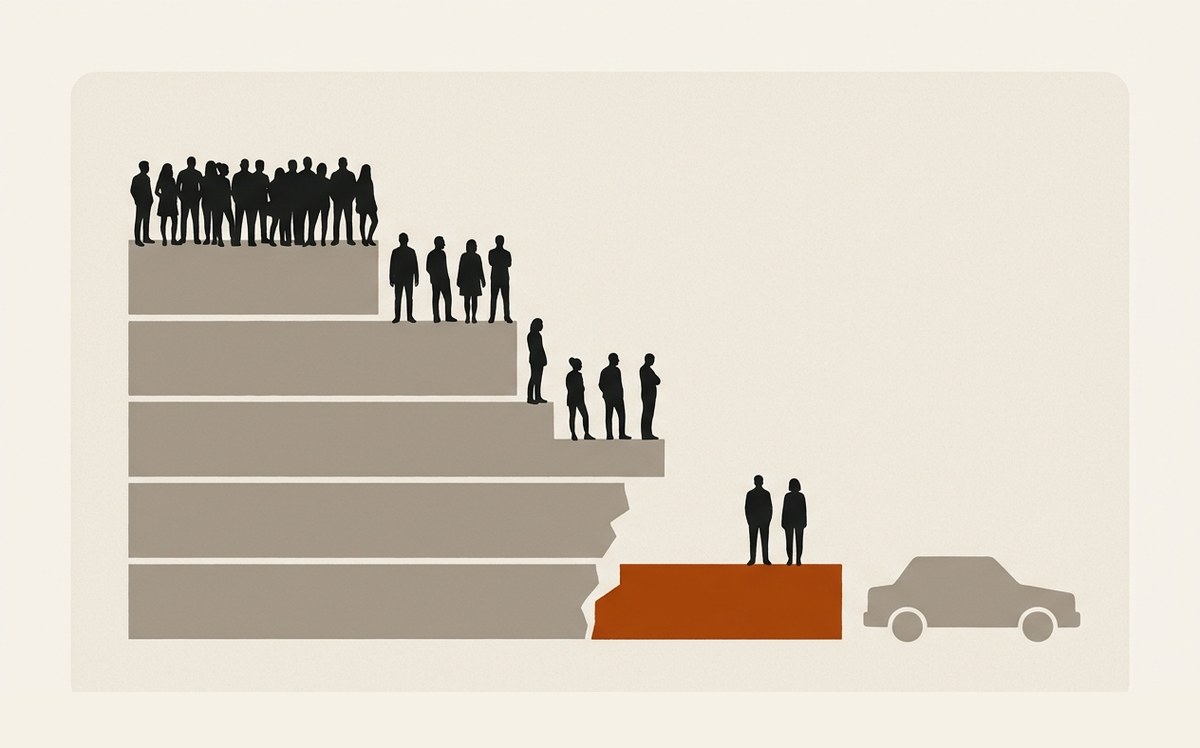
In 2015, inside the agency's digital division, we built the launch of a premium car model and we measured it all the way. Not to the click. To the test drive at the dealership, and to the sale.
The top of the funnel worked: over 3 million impressions, over 10,000 unique visitors, and click-to-visit conversion of 34% on display and 36% on search. Test drive requests came in at 0.89% of visitors, which is the standard for this kind of product.
Of all the hot leads passed to the network, only 29% resulted in a test drive actually taking place. The weak link was not the campaign, it was downstream of it.
A premium car brand was launching a new model in an island market, through a local dealer network. The media budget was modest against the brand's standards. The system combined display and search with a campaign site, a test drive request form, and lead handover to the network. What is unusual, then and now, is that the chain was instrumented along its whole length.
A car campaign does not sell cars. It produces test drive requests. Between that request and the sale sit a phone call, an appointment, an available vehicle, a trained salesperson and a follow-up. None of that belongs to the agency. Second constraint: traffic was mostly mobile, 61.6% against 38.4% on desktop, in a market where the connection is not a metropolitan one. A heavy form killed the request before it existed.
1 · Instrument the whole chain, not the campaign.
Every step gets its counter: impression, click, visitor, test drive request, test drive taken, sale. As long as a single step is missing, the debate is settled by opinion. When they are all there, the breaking point shows and nobody can dispute it.
2 · Separate display and search from the first measurement.
Two different logics, two very different click-through rates, 0.77% on display against 1.42% on search, and yet an almost identical conversion to a visit, 34% against 36%. Which means display was doing its job upstream, and judging it on its click-through rate would have led to cutting it.
3 · Design for mobile because it is the majority.
Six visitors in ten arrived on a phone. The test drive request journey was shortened and lightened for that reality, not for the desktop mock-up that goes through brand review.
4 · Write the breaking point into the report, even when it sits with the client.
The campaign report does not stop at the last favourable indicator. It states in black and white that less than a third of the hot leads were worked by the network. It is an uncomfortable finding to present. It is also the only one that unblocks anything.
5 · Make lead follow-up a brand issue.
Once the number is on the table, the conversation changes nature. It is no longer about the cost of a click, it is about the call-back time, who calls, and what happens when nobody picks up. That is a marketing director's job, not a media buyer's.
2015 launch, measured end to end.
- Over 3 million impressions and over 10,000 unique visitors on the campaign site
- Click-through of 0.77% on display and 1.42% on search, with click-to-visit conversion of 34% and 36%
- Traffic 61.6% mobile, request journey designed for that constraint
- Test drive requests at 0.89% of visitors, in line with sector standard
- 29% of hot leads worked by the network, written into the report handed to the client
- Chain instrumented from impression to sale, every step with its own counter
A campaign that delivers hot leads and a network that works fewer than a third of them is not a media problem, it is a commercial organisation problem. The only way to prove it is to have instrumented the chain before you needed to. If your marketing stops at the form, you will never know whether the problem is yours.
Does your funnel stop at the form?
The first call30 minutes. We talk about your traction and what is blocking it. You leave with 2 or 3 moves you can act on. No pitch.
Seven hundred and ten euros, and a three-figure effect
Constraint: proving campaign effect on an isolated perimeter.
Read the case studyThe client was cutting print because it proved nothing
Constraint: taking budget from an incumbent medium, with proof.
Read the case studycountry budgets, one group budget, one rule
Constraint: ten markets, ten budget formats, no line authority.
Read the case studyHalf the agency's margin came from business I had won
Constraint: selling and producing with the same people.
Read the case study