The premium brand measured all the way to the counter
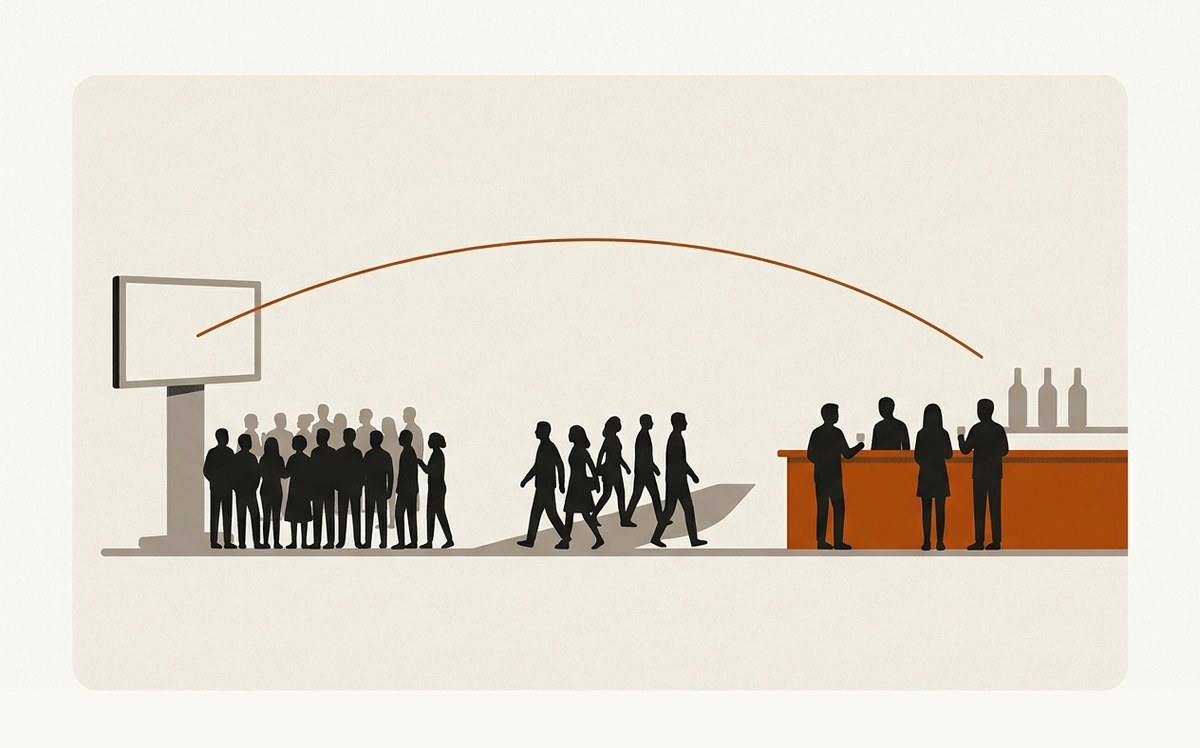
A premium spirits brand wanted a year-end operation that did something other than visibility. We built a system running from paid social to a physical tasting experience, then to purchase in store, and we measured every step.
The top of the system: 1.7 million impressions, reach of over 150,000 people, over 32,000 actions, and a click-through rate of 2.575% at a cost per action of 0.15 euro. The brand page gained 35% more followers over the six weeks of the operation.
The bottom of the system is what makes the page worth reading: over a thousand sign-ups to the experience, some of them captured in store on a tablet, then bookings, then attendance, then purchases. At every step, a percentage that drops and that can be explained.
The market is an island one, the category is premium, and the purchase is decided at the shelf, in front of six brands that look alike. Building awareness there is pointless: everyone already knows the brand. What is missing is a reason to pay more than the bottle next to it, and that reason is not installed by an advert, it is installed by an experience.
A system that runs to purchase crosses three territories that do not talk to each other: paid social, the physical event, and the point of sale. Each has its owner, its budget and its metric. Add that in a regulated category every message goes through approval, and that in-store sign-up means training hosts to capture data properly. Drop-off is not an accident, it is structural. The work is to measure it step by step rather than suffer it.
1 · Sell an experience, not a product.
The object of the campaign was not the bottle, it was a visit and a tasting. Nobody buys a premium spirit because a social ad asked them to. The invitation was to a tasting, and the purchase came afterwards, with full knowledge.
2 · Capture the sign-up where the person already is.
Part of the sign-ups was taken in store, on a tablet, by hostesses. It is the most profitable step of the set-up: the person is already in the aisle, already has their hand on the product, and signs up in thirty seconds rather than three screens.
3 · Measure every step, and publish the drop-off.
Impressions, reach, actions, site visitors, sign-ups, bookings, attendance, purchases. The report shows the pass-through rate from each step to the next. That is what lets you say where to invest the following year, instead of doing the same thing again and hoping for better.
4 · Separate paid reach from earned reach.
On another brand in the same portfolio, a comment-based game mechanic produced the biggest organic reach in the whole archive, more than 70,000 people reached over a quarter, with a moderation load to absorb. An organic mechanic that works costs human time, not media, and you need to have planned who holds it.
5 · Hold cost per action as the single reference.
On the same family of brands, the best cost per follower of the whole period comes out at 0.07 euro. It is not a vanity record: it is the reference that lets you say, campaign after campaign, whether the set-up is getting worse or better.
2014 to 2016 operations, Indian Ocean.
- 1.7 million impressions and reach of over 150,000 people across six weeks
- Over 32,000 actions at a click-through rate of 2.575% and a cost per action of 0.15 euro
- Brand page up 35% in followers over the operation
- Over a thousand sign-ups to the experience, part of them captured in store on tablet
- System tracked through to purchase at the shelf, with the pass-through rate published at each step
- Over 70,000 people reached organically on a game mechanic, on a neighbouring brand in the portfolio
- Best cost per follower of the period at 0.07 euro
A premium brand is not judged on its reach, it is judged on its ability to make someone move. Once the system is measured to the counter, the conversation with the client changes: you no longer argue about view counts, you argue about the pass-through rate between two steps, and which one to fix first.
Does your brand campaign end anywhere?
The first call30 minutes. We talk about your traction and what is blocking it. You leave with 2 or 3 moves you can act on. No pitch.
conversion, in a five-month Ghana pilot
Constraint: off-grid customers, low bandwidth, five months to prove it.
Read the case studyThe same system on three markets, three opposite results
Constraint: same system everywhere, local conditions nothing alike.
Read the case studyleads on an industrial production line
Constraint: industrial scale, profitable every month.
Read the case studyThe launch whose weak link was the dealership
Constraint: the brand delivers the leads, the network converts them.
Read the case study