Digitising a travel agency, from shop window to back office
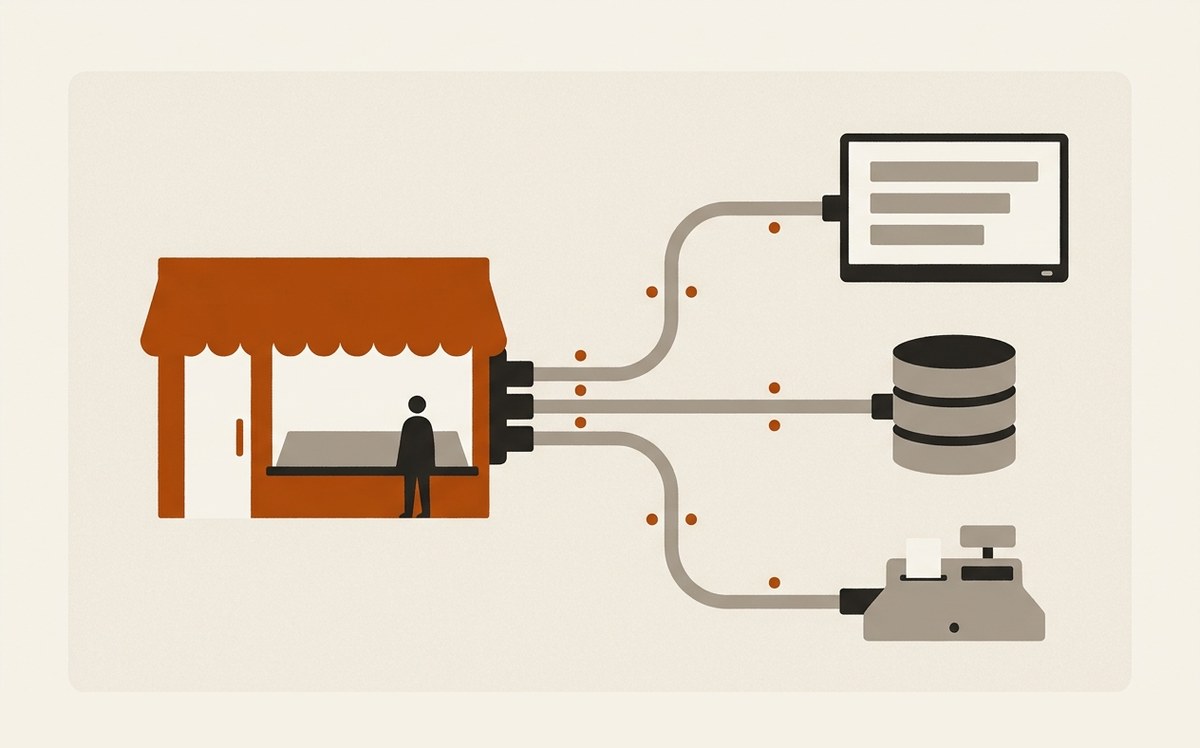
A travel agency that wants to sell online almost always starts by rebuilding its website. It is the most expensive mistake in the sector, because the site is only the shop window and the problem sits behind it.
On this account the work covered the whole chain: rebuilding the public site and the back office, opening an online shop with payment, building a quote request management tool, and a feed that fills the screens in the physical branches from the same source.
The account followed. Successive annual recommendations go from a few thousand euros in the first year to a six-figure budget in the fourth, a seventeenfold increase in three years. A client does not raise a budget like that for communications. They raise it when the tool starts earning.
A travel agency in an island market, with several physical branches, a catalogue of destinations and a customer base still largely booking at the counter. Its website worked as a brochure. Enquiries arrived by phone, by email and at the counter, and each was handled its own way. The catalogue on display in the window and on the branch screens had no connection to what was online.
Digitising a service business is not putting your catalogue on the web. It is accepting that the internal process changes. A quote request arriving through a form has to land somewhere, be assigned to someone, tracked, chased and closed. Until that somewhere exists, the form only moves the mess around. Add online payment in a market where cards are not the reflex, and in-store screens, which do not forgive stale content.
1 · Rebuild the back office at the same time as the shop window.
The public site and the management tool were treated as a single project. Rebuilding one without the other produces a fine facade that pours disorder into an organisation that has not changed.
2 · Treat a quote request as an object, not an email.
A light tool to manage requests, with an owner, a status and a follow-up. The bare minimum to stop a request getting lost between two people, well before any full customer relationship system.
3 · Open online sales on a narrow scope.
A dedicated shop with payment, on a chosen offer, rather than the whole catalogue at once. Selling online has to be learned, and it is better to learn on one shelf than on the whole company.
4 · Plug the store screens into the same source.
A bridge feeds the screens in the shops from the same content as the site. An offer corrected once is corrected everywhere. It is a technical detail, and it is what makes a team stop distrusting the tool.
5 · Launch on a date, not in a window.
The go-live of the new site was fixed in a meeting at a precise date and time. On a project that touches the back office and the shops, a vague release window becomes a permanent postponement.
2012 to 2015 account, full chain.
- Public site and back office rebuild handled as a single project
- Dedicated online shop opened, with online payment, on a chosen part of the offer
- Quote request management tool built, with owner, status and chase
- Feed filling the in-store screens from the same content source as the site
- Account budget multiplied seventeenfold in three years, from a few thousand euros to a six-figure annual recommendation
- Community recruitment at 0.27 euro per follower over the period
A budget multiplied seventeenfold in three years does not reward a campaign, it rewards a tool that changed how people work. A service business is digitised through its internal process, not through its home page. If your site is rebuilt but enquiries still land in a shared inbox, you have bought a shop window.
Is it your site that was rebuilt, or your process?
The first call30 minutes. We talk about your traction and what is blocking it. You leave with 2 or 3 moves you can act on. No pitch.
Owning a category on a market where nobody keeps the pace
Constraint: a budget that cannot buy presence.
Read the case studyWhen the audience is not a customer but an investor
Constraint: an audience that decides without ever clicking.
Read the case studyOne institutional voice, built as a system
Constraint: a B2B sector where one wrong word costs credibility.
Read the case studyA full brand identity on a four-figure envelope
Constraint: a four-figure budget, in front of an institutional audience.
Read the case study