Your competitors are your best distribution channel
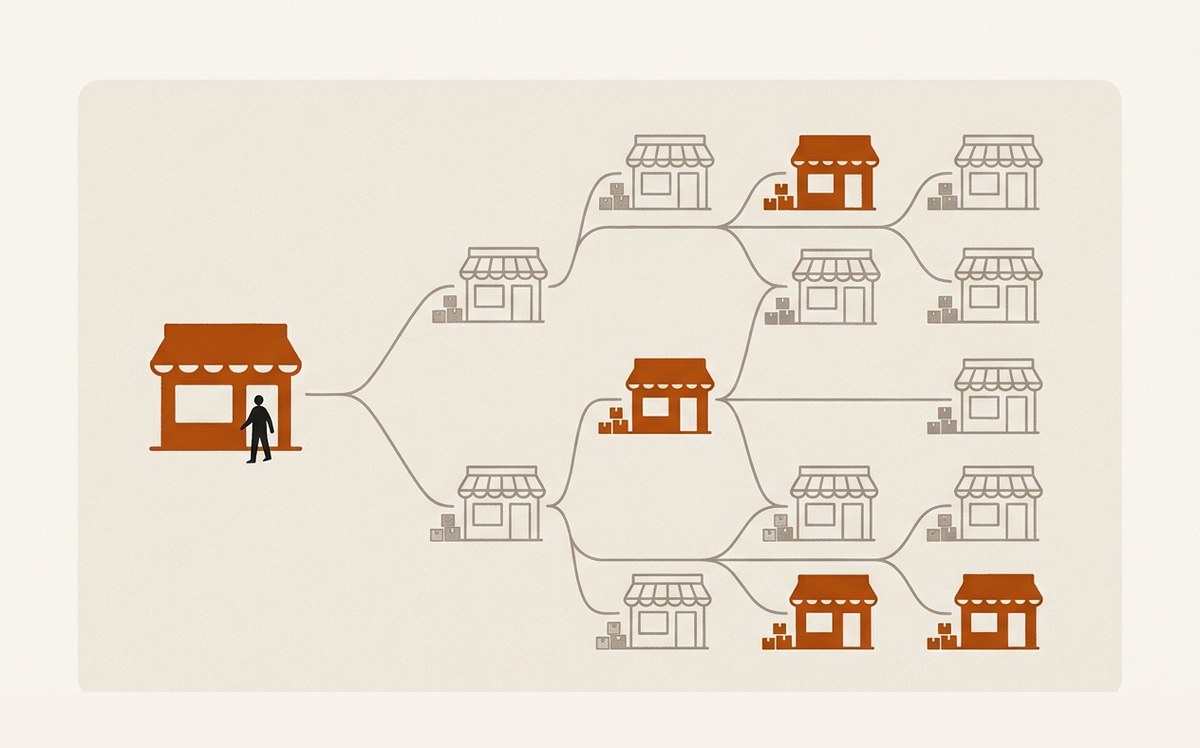
A premium retail group sold direct, in its own outlets, to customers who came to it. The model worked, and it had a ceiling: the number of chairs, the number of hours, the number of cities. Growing meant opening one more address, which means tying up capital for every increment of revenue.
The way past that ceiling was in plain sight and nobody was looking at it. The independent salons in town, the ones treated as competitors, were already using the same product. They bought it elsewhere, paid more for it, with no guarantee of origin or quality. They were not competitors to fight, they were a distribution network that did not know it was one.
In one quarter, the base of professional salons integrated into the system grew by more than 250 percent.
The group ran its own outlets in three countries, with a strong consumer brand and an imported product of consistent quality. Facing it, a dense fabric of small independent salons delivering the same service on irregular supply. The group treated them as competition. They were, on the end customer. They were not at all on the product, where the group had a purchasing and supply chain advantage none of them could match.
Selling to your competitor means answering the question they will ask: why would you help me? So you need an offer that works for them, a price that does not cannibalise retail, and a minimum order quantity that protects logistics without excluding the small ones. Add three countries, different currencies, a professional clientele buying cash and short-term, and a low average monthly basket per salon at the outset, which the advisory document itself calls low. The channel only becomes profitable through numbers, so through recruitment, so through commercial work that marketing alone does not do.
1 · Split B2B into three channels, not one.
Distributors, resellers, professionals. Three different trades, three pricing logics, three minimum quantities, three payment cycles. Treating them as a single B2B channel is the mistake that sinks most openings: the distributor wants volume and credit, the salon wants small quantities and availability.
2 · Recast the competitor as a partner.
The argument fitted in one sentence: you already use this product, you pay more for it and you do not know where it comes from. The salon gains a reliable supply and a margin, the group gains a distribution point it did not finance. Nobody loses their client: she was already going to one or the other.
3 · Set a price and minimum quantity grid.
A written grid, the same for everyone, that protects the retail price and makes negotiation pointless. It is what lets a sales rep recruit quickly, and lets the brand avoid cheapening itself in its own network.
4 · Start on consignment before selling outright.
For distributors, a consignment period, then a switch to outright purchase beyond a high sell-through threshold. The partner takes no cash risk, the group learns what really sells there, and the relationship starts on proof rather than on a promise.
5 · Open an ordering platform of your own.
Rather than handling restocking over messaging apps, an in-house resale platform, fed by media buying on search and social. In its first quarter it generated more than eleven thousand unique visitors in thirty days, and revenue measured from its first two weeks.
6 · Go after mass retail in parallel.
The same product, the same argument, another scale. Regional supermarket chains, international retailers present in several countries, pan-African marketplaces, and a European distribution network. Professional B2B pays for the logistics; mass retail raises the ceiling.
2024 mandate, three countries and an e-commerce channel.
- Base of professional salons integrated into the system up more than 250 percent in one quarter
- B2B channel segmented into three distinct trades, each with its own price grid, minimum quantity and payment cycle
- Consignment process then switch to firm purchase above a sell-through threshold, so partners start with no cash risk
- Owned reselling platform launched, over eleven thousand unique visitors in thirty days and revenue within the first two weeks
- Negotiations opened with regional supermarket chains, an international multi-country retailer, a pan-African marketplace and a European distribution network
- B2B event kit produced: stand, argument and executive speaking preparation
A retail brand's ceiling is almost never demand, it is the number of its own addresses. The fastest way past it is to look at who, in the same market, is already selling your product without you. A competitor who buys from you is no longer a competitor, it is a point of sale you did not pay for. You just have to give them a grid, a minimum quantity and a reason to stay.
Is your ceiling demand, or the number of your addresses?
The first call30 minutes. We talk about your traction and what is blocking it. You leave with 2 or 3 moves you can act on. No pitch.
A digital division built from zero across seven markets
Constraint: global brand standards on island-market budgets.
Read the case studyDigitising a travel agency, from shop window to back office
Constraint: the website was not the problem, the back office was.
Read the case studyOwning a category on a market where nobody keeps the pace
Constraint: a budget that cannot buy presence.
Read the case studyWhen the audience is not a customer but an investor
Constraint: an audience that decides without ever clicking.
Read the case study