Before, there were two segments: those who spend and everyone else
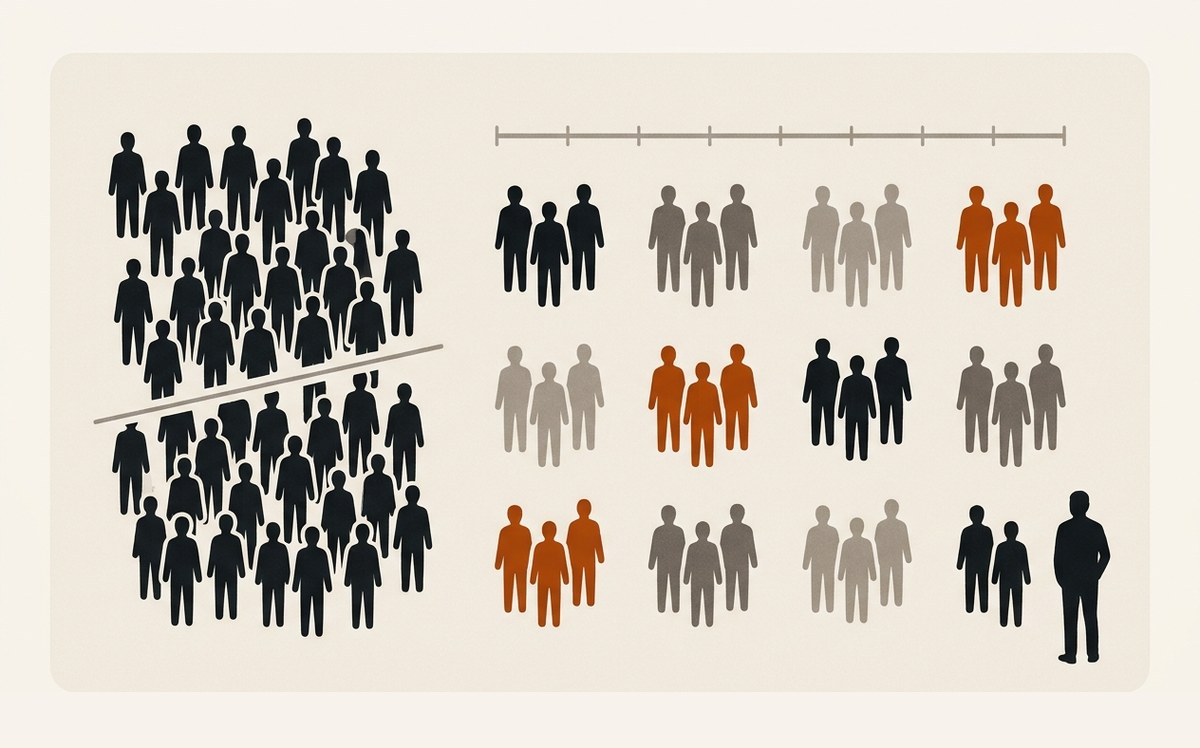
When I arrived, the company had a base of several thousand customers and two segments: those who spent a lot, and everyone else. That is not a caricature, it is the rule that actually drove discounts. Assigning a customer to a discount group was done by hand, margin was eroding under stacked discounts, and most customers had no idea which category they were in.
A two-box segmentation is not a segmentation, it is a judgement. It does not tell you when a good customer is drifting away, which one is worth calling back, or how long normally passes between two purchases. So it enables no decision, except granting a discount at the till.
The work was to build a real typology from actual transactions rather than from shop-floor impressions, then translate it into a commercial system that store teams can apply.
A premium retail group across three countries, with a European e-commerce channel. The product was strong, customers were attached to the brand, and the data existed: every till transaction had been recorded for years. Nobody had ever used it for anything but accounting. The consequence fits in one sentence: the company knew how much it had sold, it did not know to whom, or whether that person would come back.
A till database is not a customer database. Records were created on the fly, with no reliable unique identifier, with duplicates, empty fields and email addresses missing on the large majority of entries. Second constraint: whatever we built would be applied by store teams, in three countries and four languages, with no sophisticated CRM. A segmentation the till cannot read does not exist. And third: the mandate ran to development-finance standards, so everything had to be documented and transferable.
1 · Clean before segmenting, and say so.
The first deliverable is not a segmentation, it is the count of records set aside and why. Duplicates, zero-price transactions, records with no usable history. An analysis that does not publish its waste rate cannot be checked.
2 · Three methods compared, not one method imposed.
Recency, frequency, monetary value, handled three ways in parallel: a statistical segmentation by transformation and automatic grouping into four families; a quintile split with a mapping grid to ten named segments; and a weighted score, recency counting least and value most. Comparing three methods on the same base shows which ones agree and where they diverge. That disagreement is what teaches you something.
3 · Name the segments in the language of the shop floor.
Ten explicit segments rather than cluster numbers: champions, loyal, promising, new, needing attention, falling asleep, cannot lose, at risk, hibernating, lost. A sales assistant must be able to say which segment the person in front of her belongs to, without opening a spreadsheet.
4 · Measure the normal rhythm, not only the value.
The question that changes a retention strategy is not how much a client spends, it is after how many days her silence becomes abnormal. That delay was calculated by country, on the best clients, as a median and not an average, because the average is crushed by a few extreme values. That threshold is what triggers a call-back.
5 · Translate the typology into a commercial system.
A grid of cumulative spend tiers, with benefits and written rules for each, in both working languages. And a change of logic in the loyalty programme: instead of the more you buy, the bigger your discount, which eats the margin, the more you buy, the more credit you build up, which protects it and brings the client back.
6 · Fix the collection at the source.
A segmentation does not survive a database that degrades. A bilingual welcome script with a decision tree was written for the till, with the mobile number as the unique identifier, a list of mandatory fields, and a way to handle the objection on email. Collecting the data became a step in the sales journey, not a box to tick.
2024 mandate, three countries and an e-commerce channel.
- From two discount categories assigned by hand to ten named, computed segments
- Three segmentation methods built and compared on the same base, with the discard rate published
- Abnormal-silence threshold computed per country, as a median, to trigger callbacks at the right moment
- Customer tier grid written in both working languages, with benefits and rules per tier
- Loyalty logic inverted, from the discount that erodes margin to the credit that brings the customer back
- Bilingual welcome script at the till, unique identifier and mandatory fields, so the base stops degrading
- Operational reactivation campaign built on the segments, with call script and appointment booking
Plenty of companies believe they have an acquisition problem when what they have is a customer knowledge problem. As long as the base only separates those who spend from everyone else, every media pound goes on re-buying people you already had. A useful segmentation is not an analysis, it is an instrument: it names groups the teams recognise, it gives a trigger threshold, and it fills itself because collection was fixed at the same time.
Does your customer base tell you anything beyond revenue?
The first call30 minutes. We talk about your traction and what is blocking it. You leave with 2 or 3 moves you can act on. No pitch.
Your competitors are your best distribution channel
Constraint: selling to the people you took for competitors.
Read the case studyA digital division built from zero across seven markets
Constraint: global brand standards on island-market budgets.
Read the case studyDigitising a travel agency, from shop window to back office
Constraint: the website was not the problem, the back office was.
Read the case studyOwning a category on a market where nobody keeps the pace
Constraint: a budget that cannot buy presence.
Read the case study